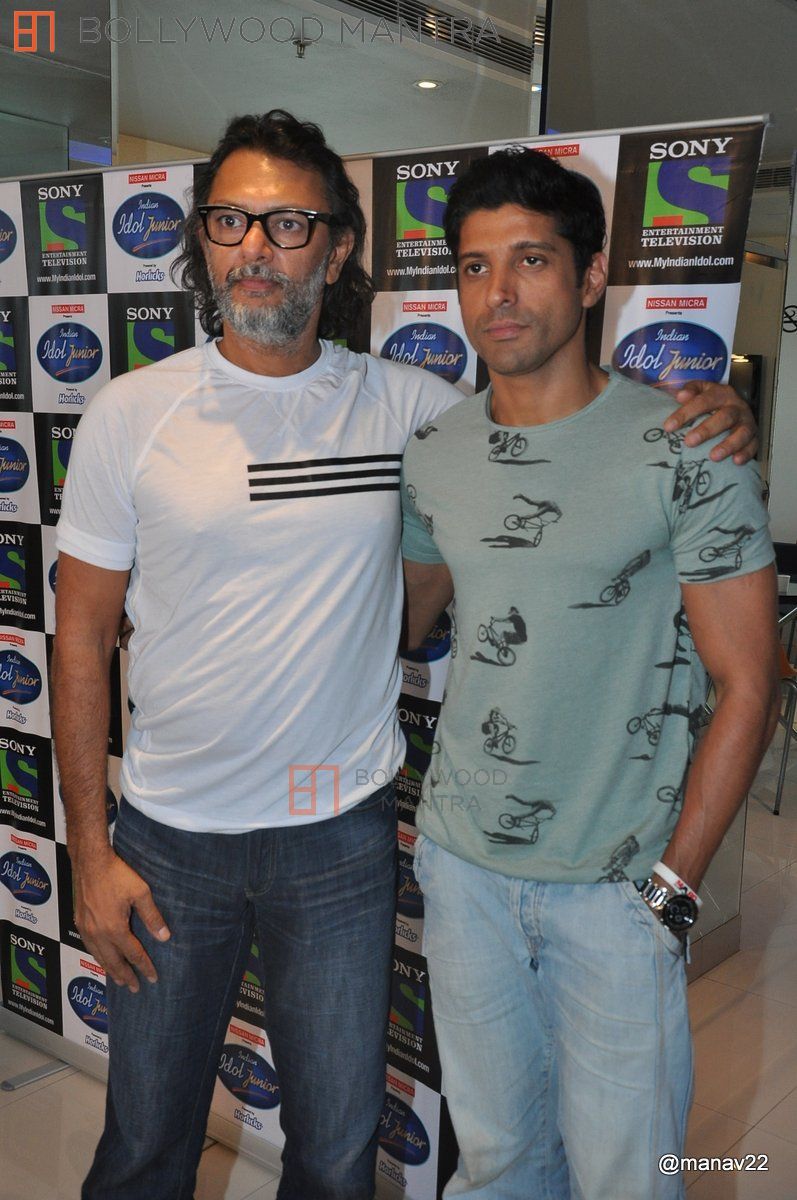
Starring Farhan Akhtar, Sonam Kapoor, Rebecca Breeds, Divya Dutta, Prakash Raj, Pavan Malhotra
Witten by Prasoon Joshi
Directed by Rakeysh Omprakash Mehra
Rating: * * * * *
History is created in several ways. One of them is cinema. And if
Rakeysh Omprakash Mehra's Bhaag Milkha Bhaag seems like a near-flawless
homage to the flying spirit of India's greatest runner it is partly
because the story, so nimbly woven into a pastiche of drama emotion
humour and pathos by Prasoon Joshi, is in no hurry to keep pace with the
on-screen Milkha's breathless sprint.

The story of super-sprinter Milkha Singh unfolds in this exceptional
bio-pic at its own volition. There's no effort here `to tell a story`,
to create an impression or to whip up a dramatic storm to captivate
audiences. The synergy in the storytelling seems subliminal.
Still, we the audience, fed week after week on mediocrity masquerading
as cinema, are riveted to the story Milkha Singh for over 3 hours of
playing-time?

How come? ! Well, to begin with it is Milkha Singh's own powerful life
as India's superstar sportsperson that sweeps us into the bio-pic.
Milkha was so poor he couldn't afford running shoes, and when he got
them he didn't know how to run in them. When milk was offered in the
army in exchange of running practice he grabbed it (the run and the
milk) with both hands.
A victim of India's brutal Partition, Milkha's story was waiting to be
told. Thankfully no one before Rakeysh Omprakash Mehra saw cinematic
potential in Milkha's story.
If Milkha's story had to be told,
the storyteller had to be a master craftsman, and one who doesn't waste
space in self-congratulatory flourishes. Rakeysh Ompraksh Mehra reins in
the drama.

With immense help from Prasoon Joshi, Mehra harnesses Milkha's
life-story into an experience that is Pure Cinema and yet undiluted and
uncompromised by the mandatory often silly illogical and idiotic
semantics of mainstream commercial cinema.
The absolutely seamless editing (by P. Bharathi) is impressive. The film
is very stylishly cut. But not at the cost of losing the saadgi, the
innate ascetism of the sportsman-hero.
And yes, there are songs,
heart-gamboling songs composed by Shankar-Ehsaan-Loy. But they are so
effortlessly woven into Milkha's saga we don't see them as `song
breaks`.
We see them as expressions of that innocent joy which
springs out of Mehra's Milkha like milk from a cow's unconditionally
nurturing udder.

And yes, this is as good a time as any to tell you, Farhan Akhtar
dances the Bhangra as well as any Punjabi. Actually, he doesn't dance.
He just flows with the rhythm. I've never seen any actor dance with such
rhapsodic abundance. Neither have I seen any actor run like Farhan.
I don't know how fast Milka ran. But Farhan's Milkha doesn't fake it for
even a second. When he runs, he really runs. When he stumbles and takes
a fall we flinch and wince in our seats. Method acting? Farhan as
Milkha takes us beyond that.
His body-language and
emotion-expression as Milkha is so pitch-perfect (pun intended) we
forget this is not the real Milkha in front of our eyes. Not since
Balraj Sahni in Garam Hawa have we seen an actor vanish so effortlessly
into his character. This is as real as it gets.

Farhan doesn't 'play' Milkha. The actor occupies Milkha, mind body and
soul. There are episodes in this astonishingly well-structured bio-pic
where Farhan's oneness with Milkha equals Ben Kingsley's empathy with
Mahatma Gandhi.
In one sequence after a night of binging with a
pretty Australian girl (Rebecca Breeds, pretty and amiable) Farhan
stands in front of the mirror and slaps himself for messing up on the
field.
Each slap makes us flinch. These are not faked slaps.
Farhan takes Milkha's pain embarrassment and self-abnegation on his
chin.

Mehra's is not a simple sports-to-glory tale like Chariots Of Fire.
This is not just a film about a sportsperson who brought untold glory to
our country.
As told by Mehra Bhaag Milkha Bhaag is the story
of an individual's journey from nullity to pinnacles of success in a
world where politics and violence are constant reminders of how little
an individual's aspirations matter in the larger often murkier scheme.

To compare it with Paan Singh Tomar would be akin to comparing the voices of Lata Mangeshkar and Asha Bhosle.
In Prasoon Joshi's interpretation of Milkha's amazing success-story, yearning is the cornerstone to achievement.
In 1947 when India became two nations we see little Milkha (Jabtej
Singh, endearing) run for his life to escape the savage butchery that
snatches away almost his entire family. (Only his dear sister, played
wonderfully by Divya Dutt) remains. This is the Sholay massacre without a
Gabbar to rationalize the evil. As we see it, Milkha never stopped
running since the trauma of Partition.

The 'run' as a metaphor of life's expedient circumstances, runs through
the narrative. Mehra's storytelling moves into crucial episodes in
Milkha's life unannounced. The brilliant unsparing editor P Bharathi
follows no predictable pattern. Yet, the editing is not selfconsciously
elusive and mystifying as it was Anurag Basu's Barfi.
Happily the screen- time is as much taken up with Milkha's
record-breaking achievements on the field, as it is with vignettes from
his personal life.

There is a robust heartwarming romance between Milkha and the
vessel-friendly kudi Biro (Sonam Kapoor, looking prettier than ever).
Writer Joshi and director Mehra invest inexpressible warmth in the
protagonist's courtship scenes. We've seen this kind of love blossom on
Punjab's soil before. But it it still feels special and unique.
Farhan does the rest.

He gets tremendous support from other actors, specially Divya Dutta who
is incomparably sincere as Milkha's supportive sister. Don't miss the
sequence between the siblings where Milkha makes his sister wear his
sports blazer. It wets eyes while transporting us into the Milkha
innerworld.
Pavan Malhotra as Milkha's coach is as usual, first-rate. Really, this actor should be doing a lot more work!

But then, Indian filmmakers seldom have the vision and insight that
Mehra invests into almost every moment of this unforgettable tale. There
are no exaggerated dramatic flourishes here, no playing to the
galleries.
Unlike other period films in recent times which have
conveniently and lazily resorted to antiques, artifacts and vintage
songs, 1950s in Bhaag Milkha Bhaag simply and effortlessly emerges from
the character and his milieu.

Binod Pradhan's camera glides across Milkha's inner and outer world
searching for a meeting point between the two worlds through visuals
that suggest a comfortable kinship between feelings and their
geopolitical counter-point. We often see Milkha on screen in situations
where his emotional world is manifested in the interaction with the
people around him.
Binod Pradhan's cinematography tells it like it is. There is a complex
design to the seeming simplicity of this saga of a simple Sikh who would
guzzle two cans of ghee on challenge and run to the winning post on
feet mauled by jealous rivals.

Who said life could ever be easy for those who aspire to fly higher than
the rest? The beautiful irony of Milkha Singh's life that this
consummate bio-pic captures so ably, is that he really didn't aspire to
anything. He ran simply because he had to.
The rest, as they say, is history. Rakeysh Mehra looks at this life of
stunning serendipity with tremendous warmth, hope and longing.
Bhaag
Milkha Bhaag is the kind of cinema that doesn't tempt us to share the
protagonist's life with any false hopes. We the audience are driven into
a desperate urge to share Milkha's life not only because he ran fast
but because he wasn't afraid to stumble, falter and fall.

Ironically this film on Milkha rarely slips up, if ever.
At one point in an under-punctuated flashback we hear Milkha confide in
his sweetheart that he would like the government to declare a national
holiday in his honour.

I recommend a national holiday for the entire nation to go and see Run
Milkha Run. It makes the other recent high-profile acclaimed films look
hopelessly inadequate.